Opendoor is missing a $13.7B vertical.
U.S. Chinese homebuyers — and Zillow is already capturing it. Here's the strategic case, and what I'd build.
From a builder · bilingual · Canadian PR-pendingFive facts on the table.
Each one independently real. Together, a market segment hiding in plain sight.
Chinese buyers, U.S. residential, one year.
From April 2024 to March 2025, Chinese buyers spent $13.7B on U.S. homes — up 83% from $7.5B the prior year. Top 1 foreign-buyer country by spend. 11,700 homes, average $1.17M each.
A symmetric match to your iBuying model.
Chinese buyers pay all-cash 71% of the time, vs 28% for U.S. domestic buyers. Your cash-offer model isn't disrupting them — it's speaking their native financial dialect. Speed beats speed.
A cultural moat your current playbook can't cross.
86% of Chinese buyers factor Feng Shui into purchase decisions. 79% will pay a 16% premium for a Feng Shui-compliant home. 36% will refuse to work with an agent who doesn't understand it. House orientation, door alignment, "road conflicts" at T-junctions — these are veto conditions, not preferences.
WeChat + Xiaohongshu. Your funnel doesn't exist there.
Chinese buyers don't search in English. Discovery happens on Xiaohongshu (the "grass-planting" content engine, 300M users), trust closes inside WeChat groups (1.3B MAU). Zillow already opened a WeChat account and built a Mandarin Premier Agents network. Opendoor hasn't.
Structural lock-in, not stereotype.
A correspondence experiment across 11 U.S. states tested real estate agents' response rates to clients of different ethnicities. Chinese agents responded to Chinese clients 151.11% more than to non-Chinese clients — the most extreme co-ethnic preference measured in the entire dataset. Buyers route to Chinese agents because Chinese agents reciprocate. The loop is closed.
ResearchGate · Real estate agent response by race & ethnicity (2023)
Not "a market." Your market.
Each fact above maps to something specific in your business — not a generic opportunity.
Your 51 metros already cover the demand.
36% of Chinese buyers are in California, 9% in New York, 9% in Maryland — all within your existing footprint. You're already on the battlefield. You're just not aiming.
Cash offer + 71% all-cash = closing-speed symmetry.
Your model wins because you offer cash fast. Their model expects cash fast. Two cash-native parties = the friction (financing contingencies, appraisal delays) that slows your standard deals doesn't exist here. Margin is structural.
Zillow is already routing around you.
Zillow's WeChat account and Mandarin Premier Agents capture the top of the funnel — the moment a Chinese buyer starts considering U.S. property. That's competitive ground you're losing right now, not theoretical risk.
Q1 2026 strategy: DTC + product suite expansion.
You publicly stated the next chapter is direct-to-consumer + new product categories. A Chinese vertical is the most defensible "new product category" available — high LTV ($1.17M average ticket), all-cash speed, and no incumbent owns it yet.
DTC vs. 151.11% agent lock-in.
Your roadmap moves toward direct-to-consumer. Chinese buyers are structurally bound to Chinese agents. This is a real contradiction — three angles to choose from, not a recommendation. Three strategic shapes.
All three options share one principle: AI is not bolt-on, it's the wedge. Non-AI versions of any of these have been tried by Chinese real estate startups and didn't break out. AI changes the unit economics — that's why the window is open now.
Concrete moves, not consulting deck.
Six specific builds I can prototype with the AI stack I already use daily — Claude Code, Cursor, MCP, Supabase, Vercel.
AI Feng Shui scoring
Score each listing on orientation, door alignment, "road conflicts" (T-junctions), and address-number numerology. Surface as a tag on the listing card. Trained on traditional Feng Shui rule sets, not vibes.
"Does this house bless you?"
Combine Feng Shui rules with the buyer's birth date + Chinese zodiac for individualized house compatibility. A personalization tool no English iBuyer can ship.
Next-gen education coefficient
School district rank + Asian/Chinese student demographics + recent Ivy/STEM placement rates. Chinese parents already do this manually — turn it into a 1-click listing score.
"This house produced X PhDs"
AI-scraped historical data: notable past residents, academic outcomes from that address. Pure cultural premium signal — the kind of detail that closes deals in Chinese WeChat groups.
WeChat + Xiaohongshu content engine
AI-generated content calendar with human curation. Daily Xiaohongshu posts → WeChat groups → cash-offer leads. End-to-end pipeline, single operator can run it.
Chinese listing pipeline (opendoor.cn?)
LLM translation + cultural adaptation. Not just Mandarin text — restructured UX, currency display in CNY equivalents, WeChat-style messaging flows.
An AI-native builder. Honestly, with limits.
I'm putting strengths and weaknesses on the same page because the AI era rewards transparency more than polish.
15+ years in creative direction — including Operations Team Leader at Tencent (4.5y), Group Creative Director at BlueFocus (China's largest comms group), and earlier senior roles at Arkr / BBDO / Publicis (2003-2018). Now shipping production SaaS solo as founder with AI-pair coding, while serving as the sole in-house designer at Westman Immigrant Services (Brandon non-profit). Currently completing Digital Art & Design Diploma at Assiniboine College (Brandon, MB). Awards: D&AD 2023 (Type & Lettering) · China 4A Golden Seal 2014 (Media Innovation Gold) · Asia-Pacific SABRE 2014.
Witness #1 — China supply side, from inside: I lived through China's real estate boom from inside the tech sector at Tencent, then watched its collapse — Evergrande, Country Garden — trigger this exact $13.7B wealth migration. To me, this isn't a data point. It's a flow I watched start in real time.
Witness #2 — Canadian buyer side, this past year: I just went through the home-buying process myself. Experienced AI integration first-hand — satellite-based AI estimating my lawn area as part of agent tooling. AI integration in real estate services is past the irreversible point. But the sharper edge was cultural: every Chinese-language realtor I worked with structured the entire buying conversation around Feng Shui. About 80% of Chinese buyers won't seriously view a property without a Feng Shui-aware agent. (Full disclosure: I'm a certified Taoist priest with active Feng Shui practice. The Feng Shui dimension isn't anthropology to me — it's literacy.)
Strengths
- AI-native shipping · 4 products, solo Live SaaS products, AI-pair coded under my architecture: → Simple Yard Sale — Canada-wide live yard sale map (Vanilla JS + Supabase + Leaflet + Vercel) → SmartStockPick — bilingual AI stock SaaS with 6-agent workflow (Google Sheets + Claude API + Jensen Huang's "AI cake" framework) → Good Morning Brandon — AI-curated daily local news, validation MVP → SimplePickPhoto (in development) — two-sided SaaS: photographers upload, clients pick. 29-page mockup system + complete design system shipped
- Builder + self-update I don't just use AI. I build with it daily, learn the new tools the week they ship, and adapt the workflow continuously. In the AI era, the skill that matters most is the loop of learning + shipping.
- Cultural + linguistic fit Chinese, fluent Mandarin, lived inside the WeChat / Xiaohongshu ecosystem.
Honest weaknesses
- Language English at CLB 6-7 (Canadian Language Benchmark — intermediate, not native). I'll write you long thoughtful documents. I'll be slower in fast English meetings. In the AI era this is no longer the bottleneck it was three years ago — but I want you to know upfront.
- Location Currently in Brandon, MB. Canadian PR expected mid-2027. I cannot relocate to Toronto before PR is granted (visa logic). I understand the value of in-office. Post-PR, willing to relocate.
- If timing doesn't work This document is also my way of staying connected. If now isn't the moment — a future role, or a different current role that fits — either is welcome.
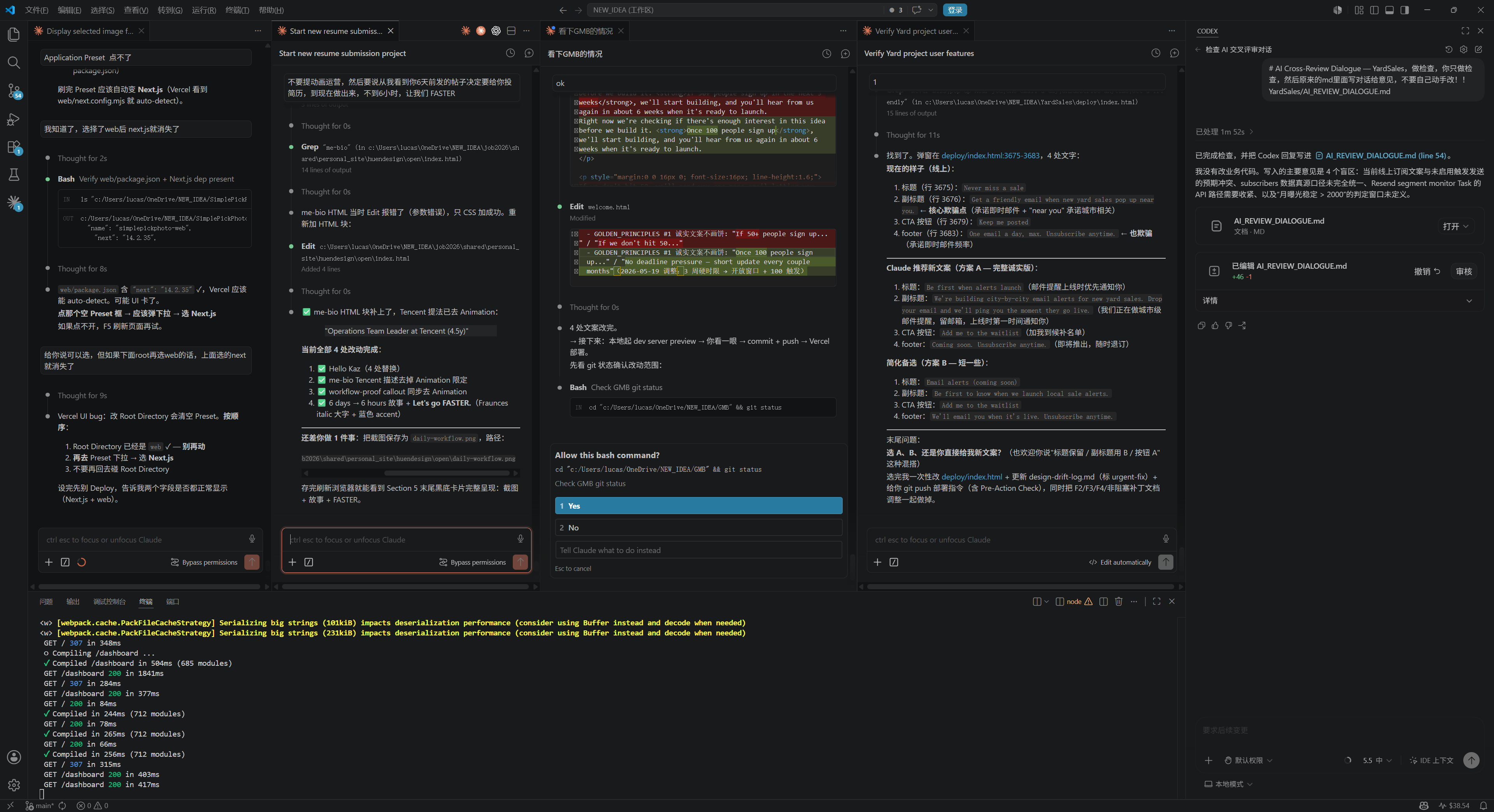
This is what my Tuesday morning looks like.
- 4 Claude Code agents running in parallel on my own projects
- +1 Codex session running as the independent reviewer
Not vibe coding. A multi-agent orchestration with explicit roles, and an anti-drift workflow I designed myself — ported directly from my 4.5 years leading Operations at Tencent. Cross-review loops, scope guards, decision-record protocols. The discipline that kept high-volume content ops shipping clean is the same discipline that keeps 5 AI agents from drifting.
In the AI era, the moat isn't using AI. It's running it as a system.
PS — Saw your X post this morning. (It's 6 days old. I'm late.) From "saw the post" to "this page is live": under 6 hours, end-to-end — research, copy, design, code, deployment. Only the DM I sent you was typed by hand.
Let's go FASTER.
I'm not pitching from outside.
Why I already care about Opendoor.
- Was an OPEN shareholder — ~$100K USD full-port at peak, all in OPEN (~5,010 common shares).
- Received your 2025 "Shareholder-First Dividend" (Nov 21 distribution, ratio 1:30 per share × 3 series). Currently holding 167 of each: OPENW + OPENL + OPENZ.
- Volunteer community ops in the OPEN Chinese-speaking Discord run by Yao (a well-known U.S.-market analyst in the Chinese investing community) — currently 400 members.
- Eric Jackson is in the group too. I assume I don't need to introduce him to you.
- I believe your "Uber of real estate" thesis. Planning to add OPEN common shares on dips.
This is me putting real money behind Opendoor.
The case above is me putting real thinking behind it too.
It's not 82 yet.
The ask.
Not asking you to hire me. If the Chinese-vertical thesis resonates — even just as a "we should think about this" — let's do a 30-minute chat. Worst case, you got a free strategic memo.